
You're the writer, right?
The truth comes out in an awkward elevator moment

Earlier this week, a neighbor caught me in the elevator. We’re a bit like the Arconia, but nobody’s been killed yet. Give us time. We’re new.
She said, “you’re the writer, right?”
“Yes,” I answer, in the voice that means oh shit, what did I do this time. It is absolutely lovely to be known as “the writer,” but so few know that the term “writer” means that most days I can be found hitting my head against a wall. On purpose.
“How’s that going?” she asked.
I think about lying. In fact, I really want to, but the little polite lie gets caught in my throat. It’s like we get caught between floors and the elevator stops moving, but it’s really just me, caught in an almost-lie, trying not to say that writing sucks.
In fact, at the moment, it’s the fall of Rome bad. If given a choice between training for a marathon, hiking a 14er, or preparing for the zombie apocalypse, I would choose any of the above to avoid writing. Because it’s hell.
Instead, the words just slip out. “It’s hard to write when the world is noisy.”
I knew I was deep in Eeyore Land of late, but I didn’t know I felt that, and yet here it is, sitting in the stale elevator air as we both watch the numbers count down to the parking garage.

The world has always been noisy.
What non-writers and my neighbor don’t know is that a writer’s mood rises and falls with the writing. If we’re in flow, the world is sunshine and rainbows. If we’re not, the world is the sixth circle of hell. I’ve been there so long I’ve stopped feeling the heat.
Write daily
Write daily, they say, it works, they say.
No one has resisted the advice to write daily more than I. I practically made it my tagline. As a binge writer, I was doing okay.
Until I wasn’t.
I wrote 10 books on caffeine and an inhuman drive to write, write, WRITE, but once COVID hit, and we moved online, my routine became less binge-y and more avoidant. It’s really hard to stay in the writing groove at the speed of a sloth. And the longer the delay, the worse it gets.
Which is why we should write daily, like taking vitamins or going to work. Because it is work, even when we’re in the flow. Writing every day may be the reason we actually hit the flow state.
Not that you have to write for ten hours a day. Pace yourself. I have a friend who wrote her first published novel while on her 30-minute lunch break. If you did that, just 30 minutes a day 5 days a week, you could meet a goal of 1500 words a week. Maybe 2000 words if you wrote EVERY day. And you don’t have to give up gym time or work time or time with your kids. You just have to do it. Every day.
Writing daily…
keeps the story alive (less backtracking or changing the plot)
builds momentum (just like the gym)
builds muscle memory (yes, your brain needs that too)
engenders consistent creative output (you’re writing again!)
makes you feel like a writer (not a poser)
Two additional benefits
Modern life is not built for “free” writing time. We can dream about an ideal time when we can slow down, sip our morning coffee, take a leisurely morning walk, and then write like we imagine Stephen King or Nora Roberts are doing until we’re done for the day, wherein we spend our time reading. But I haven’t found that life yet, and most likely, you haven’t either.
You have jobs and kids and commitments. You have less time today than you did yesterday. You want to go to the gym so you don’t die young or have a social life or just crash every once in awhile, but once you break the habit, trust me, it will get worse.
Last year, I challenged several writers to write for just 2 minutes a day. NO ONE completed the challenge. And now I’m asking you to do 30, because I think 2 minutes felt too gimmicky. Plus there was no need to alter your behavior or patterns, so it didn’t stick. So this time, we’re upping the ante for solid reasons.
30 minutes a day will help build a routine, and that’s what we need. That’s what all writers need. We like to believe that writing is based on talent and craft (and maybe inspiration), not time in the chair, and we are wrong. Time sitting in the chair is exactly what we need to build a routine. Routine is how we get shit done.
Does that mean that every 30 minutes is stellar writing? Not even close. But it’s teaching your brain (the muse, the universe, however you think of it) that this is what we do at this time of day. Every day. And pretty soon, the brain is on board. When we get to “that time of the day”, the brain knows that THIS is our writing time. It’s prepared, and it’s been thinking about it while we’ve been living life.
Most of us have habits that we do daily, like getting up, brushing our teeth, taking a shower, etc. But unless or until we make writing a habit, it probably won’t stick for the long term. There aren’t enough abracadabra moments to finish a book anytime in the near future. We have to create those magic writing moments through hard work. One day after consecutive day.
Where you put those 30 minutes is up to you. If you’re an early riser, go for it. If you have better focus mid-day (lunch-time?), then use that time. If you write better at night, then wait until the house turns quiet and write. But commit to yourself to write for 30 minutes a day, 5-7 days a week. It will make a difference.
The other big difference with writing every day is that it disempowers your inner critic. We all call that inner critic different things. For me, it’s Doubting Thomas, because it doubts I’ll ever get published (despite ten published books). The longer of a break you take between sessions, the louder Doubting Thomas gets. He’s up in your grill, trash talking, telling you what you can’t do and why. But the more you write on a consistent basis, the less space he has to talk. You’re showing him that you can indeed write (without his permission).
Write where you are
The world is noisy right now. It’s not your imagination. The news, social media, people we know… The world bombards us with, “look at me, look at me, look at me!” it seems to say.
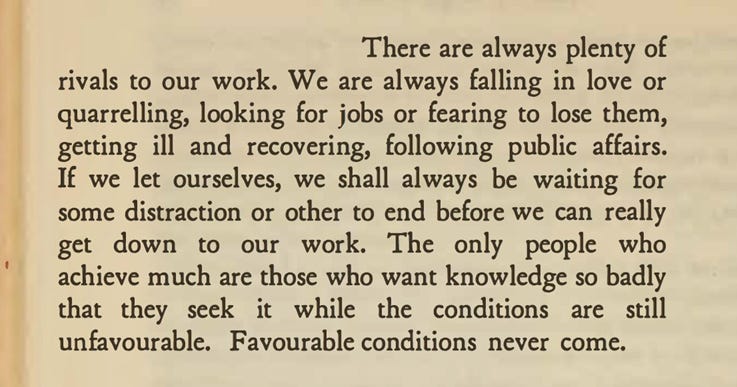
But the world has always been noisy. There have been other “unprecedented times.” Writers want and need to know what’s happening in the world, to bear witness, but sometimes, we get lost in it, and forget that our job is to write the story. As C.S. Lewis said, “If we let ourselves, we shall always be waiting for some distraction or other to end before we can really get down to our work.” (1939, “Learning in War-Time”). The noise will continue. Write anyway. Write where you are. Wherever you are, whenever you are, always and ever. Write.
Cindy Skaggs is a writer, book coach, public speaker, and military veteran who holds an MFA from Pacific Lutheran University and an MA in Creative Writing from Regis University. She is an advocate for military and veteran issues, mom to two humans, and an avid traveler. In 2022, she moved to Ireland to study Irish Literature. It seemed like a good idea at the time.
Thanks for reading The Write Place! Join us on this writing journey. Subscribe for free to receive new posts and support my work.
Consistency is the hardest. I'll give daily or weekdays another try. Cindy, thanks for the nudge to get back on the momentum track.
Good advice. I tell my students to aim for 15 minutes five times a week. They'll probably write for longer, but if they exceed 15 mins they'll feel like a success and hopefully keep going. Also, I put writing time on my calendar. There's something about seeing it there that helps...